
St. Louis County Criminal Court Records
A criminal court record is the court case file opened after the prosecutor or other charging authority files a criminal case. In St. Louis County, that file is maintained through the 21st Judicial Circuit and its criminal or associate criminal divisions. The case file is broader than a charge line. It can include the complaint, information, or indictment; docket entries; bond; attorney appearances; arraignment; motions; hearings; trial settings; plea; verdict; disposition; sentence; probation; and warrant activity.
St. Louis County criminal court records should also be kept separate from arrest records and jail custody records. An arrest may appear in a jail locator, and a charge may appear in a charge table, but the criminal court file is where the outcome is tracked. For a closer look at the charge line itself, use the county's arrest records and court charges material. For the broader case-search framework, use St. Louis County court records.
Search St. Louis County Criminal Cases
The main search path for St. Louis County criminal court records is Missouri Case.net. The county's Find My Case instructions tell users to search by case number or litigant name and use Track This Case for updates. A defendant-name search can work, but criminal results should be narrowed to St. Louis County or the 21st Judicial Circuit when possible. The case should then be read through disposition and sentencing, not stopped at the first charge entry.
- Open Case.net and choose a case-number or litigant-name search.
- Enter the full case number when known, or search by defendant last name and first name.
- Narrow by court location, judicial circuit, case type, year, or filing date where the search screen allows it.
- Open the case and review the docket, charges, bond, counsel, hearings, warrants, plea, disposition, and sentence.
- Contact the Circuit Clerk for certified copies, older files, or documents that are not remotely visible.
Municipal ordinance cases and low-level traffic-related criminal matters can be split across the St. Louis County Municipal Court, city municipal courts, and associate criminal/traffic divisions. If a criminal case search does not find a local ordinance matter, check the specific municipal court named on the ticket or summons.
St. Louis County Criminal Case Flow
Criminal court records in St. Louis County are easiest to read as a process. The docket begins after a charge is filed and then records each court step. Some cases end quickly through dismissal or plea. Others move through pretrial motions, trial settings, verdict, and sentencing. A warrant event may appear if a defendant misses court or a court order requires arrest, and a bond entry may show the terms tied to release.
Case flow: Charges Filed › Arraignment › Pretrial › Plea or Trial › Disposition › Sentencing
| Stage | What Happens in the Record |
|---|---|
| Charges filed | The complaint, information, or indictment opens the criminal case and lists alleged offenses. |
| Arraignment | The defendant appears for formal charge handling and plea-related settings. |
| Pretrial | The docket may show motions, discovery issues, bond review, continuances, and hearing settings. |
| Plea or trial | The record shows whether the case proceeds by guilty plea, trial, dismissal, or other disposition. |
| Disposition | The court records how each charge ended, including guilty, not guilty, dismissed, or amended results. |
| Sentencing | The docket and judgment may show sentence, probation, costs, restitution, or related obligations. |
St. Louis County Criminal Record Fields
A St. Louis County criminal court record can contain both case-level and charge-level information. The case-level data identifies the court, parties, attorney appearances, judge or commissioner, filing date, and status. The charge-level data identifies each alleged offense, statute or ordinance, charge level, plea, disposition, and sentence when public. The docket is the timeline tying those fields together.
| Field | What It Shows |
|---|---|
| Case number | The court identifier used for exact search, clerk copies, and court communication. |
| Defendant | The accused person named in the criminal case. |
| Prosecutor and defense | The prosecuting attorney and defense counsel where public. |
| Charge | The alleged offense, statute or ordinance, and charge level. |
| Bond | Bond amount, type, conditions, or bond events where public. |
| Docket entries | Filings, hearings, motions, orders, continuances, warrant events, pleas, and sentencing entries. |
| Plea | The defendant's formal answer to a charge, such as guilty or not guilty. |
| Disposition | How a charge or case ended, such as dismissed, guilty plea, verdict, or other final result. |
| Sentence / probation | The court-ordered penalty or supervision after conviction where public. |
Charges and Convictions Compared
A charge is an accusation filed in court. A conviction is a result after a guilty plea, guilty finding, or verdict. St. Louis County criminal court records may show charges that were amended, reduced, dismissed, or ended in not guilty. For that reason, a case should be read through the final disposition and sentence before it is treated as an outcome.
| Issue | Charge | Conviction |
|---|---|---|
| Meaning | An alleged offense filed in court. | A guilty plea, guilty finding, or guilty verdict. |
| Timing | Appears early in the criminal case. | Appears only after plea, verdict, or final finding. |
| Record clue | Look for complaint, information, indictment, charge line, or amended charge. | Look for plea, disposition, judgment, sentence, or probation entry. |
| Risk of misread | A charge may be dropped or reduced. | A conviction may still later be closed if expungement is granted. |
St. Louis County Criminal Case Offices
The St. Louis County Prosecuting Attorney files state criminal charges in the county. Research identifies Melissa Price Smith as Prosecuting Attorney, sworn in on January 3, 2025. The office is at 100 S. Central Ave, 2nd Floor, Clayton, MO 63105, and the phone number is 314-615-2610. The prosecutor's filings are a key source of the charge document and later amendments, dismissals, plea agreements, or trial settings reflected in the docket.
The source image for the Prosecuting Attorney biography connects St. Louis County criminal court records to the office that files state charges.
That office role explains why prosecutor appearances and charging-document changes can be central to reading a criminal case file.
The Missouri State Public Defender Clayton District 21 office is another important criminal-record contact point. Research lists District Defender Beverly Hauber at 100 S. Central, 2nd Floor, Clayton, MO 63105, phone 314-987-5054, fax 877-635-4602, and email Beverly.Hauber@mspd.mo.gov. A defender appearance in the court record shows counsel, not guilt or innocence.
Bond Warrants and Court Dates
St. Louis County criminal court records may show bond amount or type, warrant issued or recalled, next court date, hearing room, and status updates. Associate criminal/traffic divisions 32, 33, and 39 are part of the local criminal and traffic structure. Divisions 32 and 33 are listed in Justice Center rooms 3A and 3B, while division 39 is listed in the court roster as an associate criminal/traffic division.
Warrant fields should be verified carefully. A Case.net docket may show an issued warrant, a recalled warrant, or a next court date after arrest, but court status can lag. If the concern is an active warrant rather than the whole criminal case file, the St. Louis County warrant records path should be checked along with the issuing court.
Note: A warrant event in a docket is a court status clue, not a substitute for confirmation from the issuing court.
Treatment Court and Criminal Records
St. Louis County Treatment Court programs add useful context to some criminal court records. The official Treatment Court page lists Co-Occurring Disorders Court, Adult Drug Court, DWI Court, Family Treatment Court SAFETI, Mental Health Court, and Veteran Treatment Court. These programs can involve structured supervision, treatment, review hearings, team reporting, incentives, sanctions, and continued court oversight when a participant is eligible and accepted.
The source image for St. Louis County Treatment Court programs shows the court-run specialty programs that may appear in or near criminal court records.
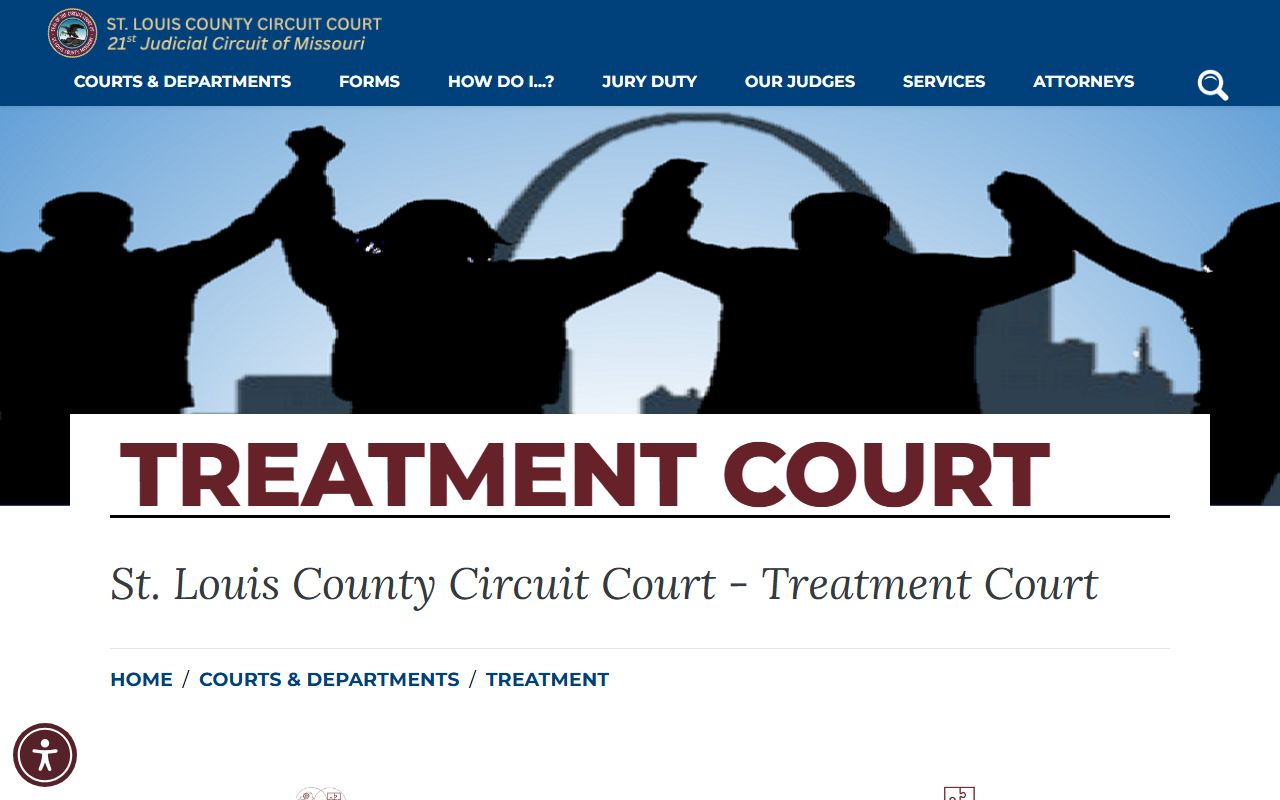
Treatment court references should be read as case-management context, not as a generic dismissal or expungement result.
Federal Criminal Records Near St. Louis County
Some criminal cases involving St. Louis County residents or events are federal rather than county cases. Federal criminal dockets for the Eastern District of Missouri are separate from St. Louis County Circuit Court records and use federal court systems such as PACER. The U.S. Attorney's Office for the Eastern District of Missouri is the federal prosecutor, not the county prosecutor. Federal case access, fees, custodial agencies, and court addresses should not be mixed with Missouri Case.net results.
The source image for the Eastern District of Missouri U.S. Attorney helps distinguish federal criminal matters from St. Louis County criminal court records.
That distinction prevents a federal prosecution from being mistaken for a missing state criminal case in the county docket.
Sealed and Expunged Criminal Records
Missouri law limits public access to some St. Louis County criminal court records. RSMo 610.140 provides the procedure for eligible criminal-record expungement. RSMo 610.120 says closed records are not destroyed, but are unavailable to the general public except for defendants and specified agencies. Juvenile files are restricted under RSMo 211.321. Arrest-only relief may fall under RSMo 610.122 when charges were dismissed, not filed, or ended in not guilty.
| Issue | Sealed or Closed | Expunged |
|---|---|---|
| Public access | Restricted from ordinary public view by court order or law. | Closed from public view if the court grants statutory expungement. |
| Record status | The record still exists in court or agency systems. | The record is closed, not physically erased from every government system. |
| Who may see it | Depends on the order, statute, defendant access, and listed agency access. | Defendant and specified criminal justice or licensing agencies may retain access under law. |
| Common examples | Juvenile, adoption, mental-health, protected data, or sealed filings. | Eligible criminal cases under RSMo 610.140 or arrest-only relief under RSMo 610.122. |
Public Access to Criminal Records
Public St. Louis County criminal court records are searched through Case.net and requested through the court that holds the file. Case.net may show public documents under Missouri court access rules, but confidential material remains blocked. The Circuit Clerk at 105 South Central Avenue, Clayton, MO 63105 handles circuit case files and copy requests, with public phone 314-615-8029. Research also located 314-615-8015 as a certified-copy related phone.
Criminal background use is different from casual court lookup. This privately operated site is not a consumer reporting agency, and court-record information may not be used for credit, employment, tenant, insurance, or other FCRA-regulated decisions through this source. For certified court proof, request the document from the court that issued it.
Restricted St. Louis County Criminal Records
Restricted criminal records include juvenile matters, sealed filings, expunged cases, arrest records after no conviction, adoption-linked material, mental-health or civil-commitment records, and documents with protected identifiers. Redactions may remove Social Security numbers, financial account numbers, minor names, victim information, protected addresses, and medical or mental-health details. A public case header may still appear even when documents are blocked, and a docket may show less detail than the court file contains.
If a St. Louis County criminal court record cannot be found online, possible reasons include a wrong court level, a city municipal case, St. Louis City confusion, an older file, a sealed or expunged record, a juvenile matter, or a delayed docket update. The most reliable fallback is the Circuit Clerk, the issuing municipal court, or the attorney of record.