
St. Louis County Arrest Records and Court Charges
Arrest records are not the same thing as the court charge record. In St. Louis County, the booking side is tied to custody information maintained through Justice Services and the public inmate locator. That custody record may identify the person, facility, arrest date and time, release date and time if released, and a charge table. The court charge record begins when charges are filed in the appropriate court and then moves through docket entries, hearings, pleas, amendments, dismissals, bond activity and final disposition.
For state criminal matters, the St. Louis County Prosecuting Attorney files charges in the 21st Judicial Circuit. Municipal ordinance matters may instead come from St. Louis County Municipal Court or a city municipal court. A jail charge entry can help identify the case number and next court date, but it is not proof of guilt and is not the final case outcome. Dispositions must be checked in Missouri Case.net and, where applicable, St. Louis Municipal Court or the municipal court that owns the case.
The Department of Justice Services page is the official county source for jail management responsibilities.
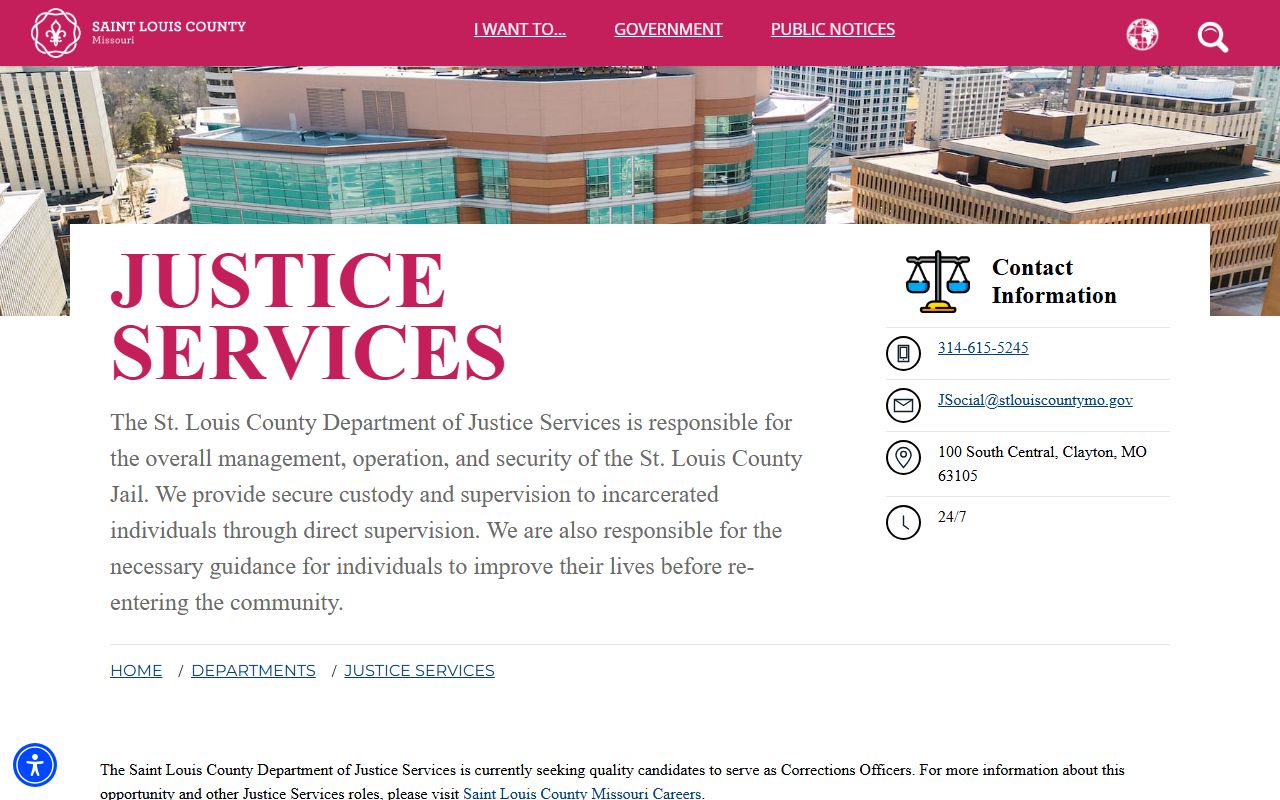
That agency context matters because St. Louis County jail custody is handled through Justice Services rather than a separate sheriff-run jail database.
How to Find St. Louis County Arrest Records and Charges
Start by deciding whether the question is about custody, the charge filed in court, or the full criminal case file. Current custody and recent release information belongs with the inmate locator. Formal court charges are searched through Case.net for circuit cases, the county municipal case-search and Tyler payment portal for county municipal matters, and the specific city municipal court when the case arose in a city court such as Florissant, Kirkwood, Manchester, University City, Webster Groves or another local municipality.
- Search Missouri Case.net by defendant name or case number and narrow to St. Louis County or the 21st Judicial Circuit when possible.
- Open the case and review the charge description, statute or ordinance, charge level, bond, hearing and disposition fields that are public.
- Check the jail locator if the person may still be in custody or may have been released in the past 72 hours.
- For ordinance or traffic-related charges, search St. Louis County Municipal Court, the Tyler portal, or the city municipal court listed on the 21st Circuit Municipal Division page.
- For copies, certified records or documents not visible online, contact the Circuit Clerk or the municipal clerk for the court that filed the case.
The St. Louis inmate locator is useful when the custody question comes first.
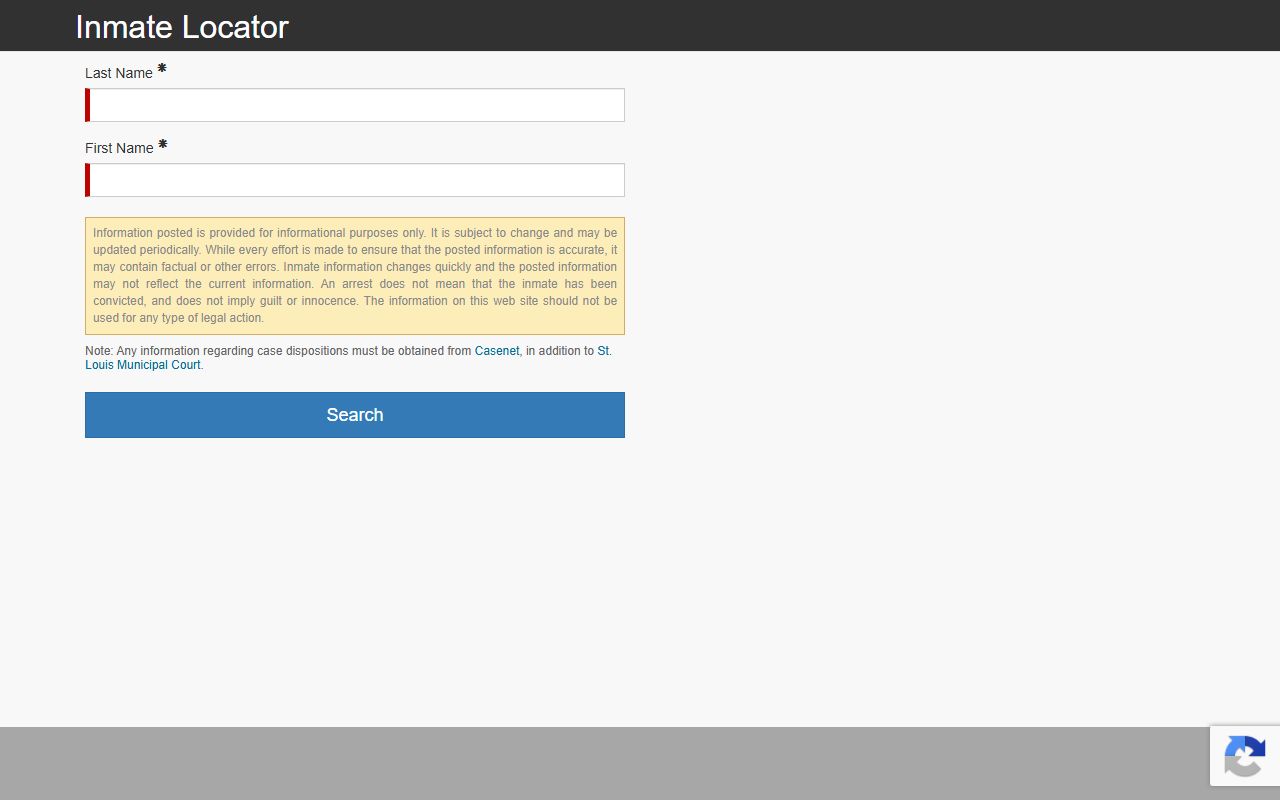
The locator can point to a case number, charge status, bond amount or next court date, but the court case still needs to be verified separately.
Jail Charge Table Fields
The public inmate profile sample in the research shows a compact charge table. That table is a custody snapshot, not a complete criminal-history report. It may change quickly as charges are filed, amended, dropped, dismissed or disposed in court.
| Field | How to Read It |
|---|---|
| Charge | The listed offense or ordinance accusation tied to the custody entry. |
| Case # | The court number to use in Case.net or the relevant municipal court system. |
| Next Court Date | The next scheduled appearance when available in the jail profile. |
| Status | A current custody or charge status, which may not be the final court disposition. |
| Bond Amount | The posted bond amount, if one is listed. |
| Bond Type | The bond category, such as recognizance, surety, cash or another court-set type when shown. |
How Charges Get Filed After an Arrest: Complaint, Information, and Indictment
After an arrest, the court charge record is created through a charging document. The local prosecuting office is the St. Louis County Prosecuting Attorney's Office. The official research identifies Prosecuting Attorney Melissa Price Smith at 100 S. Central Ave, 2nd Floor, Clayton, MO 63105, phone 314-615-2610. That office files many state criminal charges in St. Louis County Circuit Court. Municipal prosecutors handle ordinance charges in the county municipal court or city municipal courts.
| Document | Filed By | What It Does |
|---|---|---|
| Complaint | Prosecutor or law-enforcement-supported filing | Starts or supports a criminal accusation in court. |
| Information | Prosecutor | States the formal prosecutor-filed charge, often used for felony or misdemeanor prosecution. |
| Indictment | Grand jury | Creates a formal charge after grand-jury action. |
The St. Louis County Police jail information page directs inmate-information questions to Justice Services.
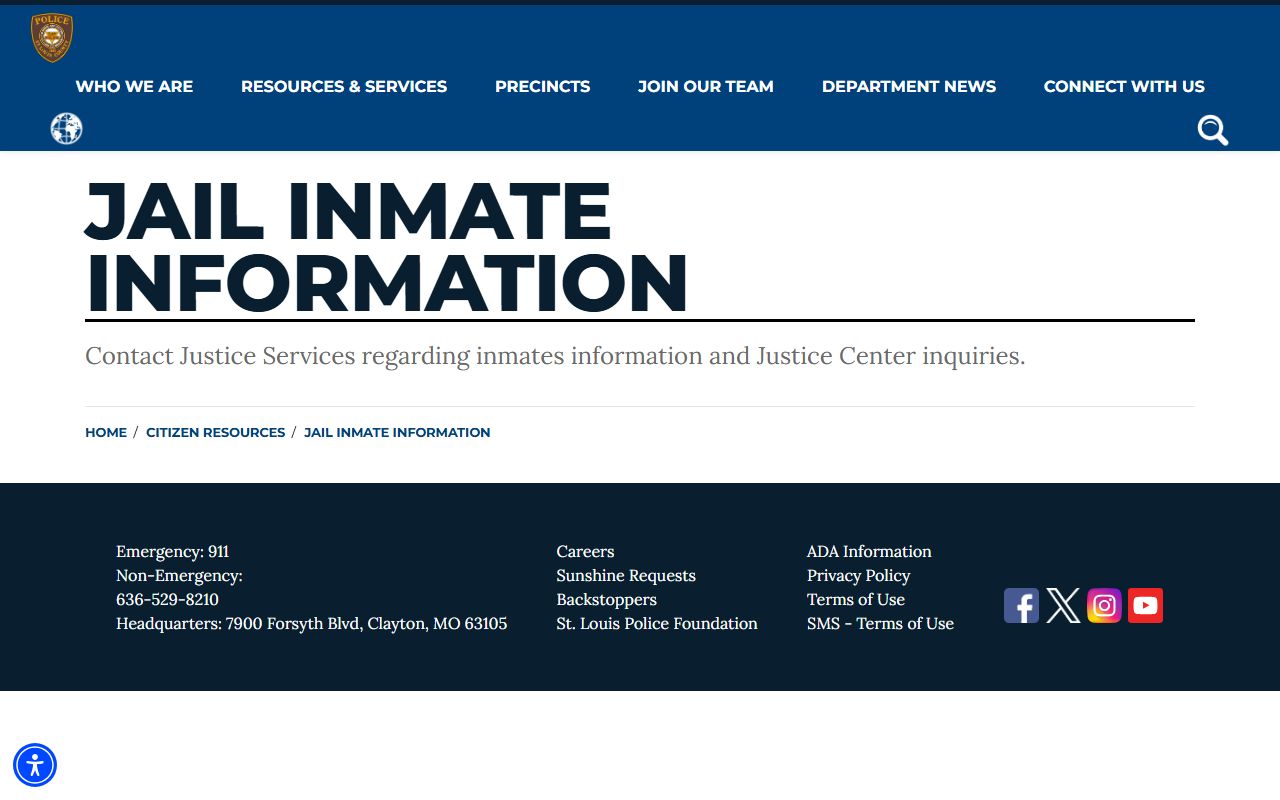
That routing is another reminder that police contact, jail custody and formal court charges are related but separate record paths.
Charge Status and What It Means
A charge can change several times before a case closes. One arrest may produce multiple charge lines, and each line can have its own status. Read the docket events together with the charge table so an old charge line is not mistaken for the final outcome.
| Status | What It Means |
|---|---|
| Pending | The charge is still open or awaiting further court action. |
| Amended | The prosecutor or court record changed the charge language, level or statute reference. |
| Reduced | The charge was changed to a lower offense or lower severity level. |
| Dropped or Dismissed | The charge is no longer being pursued in that case, subject to the exact docket language. |
| Nolle Prosequi | The prosecutor declined to continue prosecuting that charge. |
| Disposed | The charge reached an ending event such as plea, finding, dismissal or other final disposition. |
Charges vs. Convictions
A charge is an accusation filed in court. A conviction is a result after a plea or finding of guilt. The inmate locator specifically warns that arrest does not mean conviction and does not imply guilt or innocence. That distinction is critical for St. Louis County arrest records because the booking event can appear before a prosecutor files, reduces or dismisses a charge.
| Charge | Conviction | |
|---|---|---|
| Stage | Accusation after arrest or filing | Final result after plea or finding |
| Where It Appears | Case.net, jail locator charge table, municipal portal or prosecutor filing | Case.net disposition, municipal case record or sentencing entry |
| Can Change | May be amended, reduced, dropped or dismissed | Can be affected by appeal, post-conviction action or expungement if allowed |
| Use for Decisions | Verify carefully and do not treat as proof of guilt | Verify the official disposition and any later court action |
Municipal Charges and St. Louis County Fragmentation
Municipal fragmentation is central in St. Louis County. Traffic, ordinance and bench-warrant matters may be in St. Louis County Municipal Court or in a city municipal court rather than the main circuit criminal docket. The research identifies examples from the official Municipal Division list including Ballwin, Florissant, Kirkwood, Manchester, University City, Webster Groves, Wildwood and many others. If Case.net does not show the expected charge, the next search should be the county municipal portal or the court named on the citation, bond paperwork or jail entry.
The Missouri DOC Offender Search is a separate statewide custody and supervision resource.
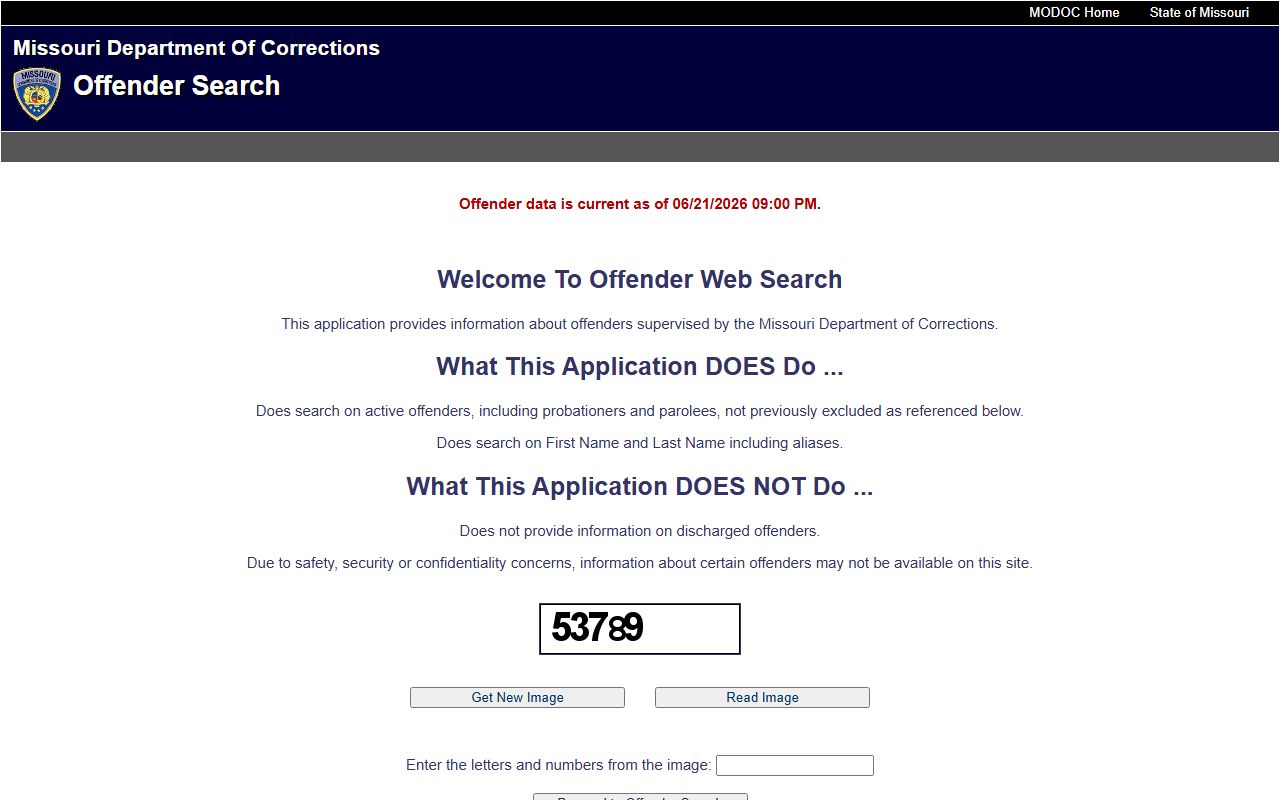
DOC records are useful when a person has moved from county custody into state supervision, but DOC search results do not replace the St. Louis County court charge record.
Sealed, Closed and Expunged Charge Records
Missouri public access rules allow many court records to be searched, but several record types are withheld or narrowed. RSMo 610.122 addresses arrest-record expungement after dismissal, nolle prosequi, no charge filed or not guilty, subject to statutory conditions. RSMo 610.140 addresses criminal-record expungement. RSMo 610.120 states that closed records are not destroyed, but are inaccessible to the general public except for the defendant and specified agencies. RSMo 211.321 makes juvenile court records confidential with statutory exceptions.
| Record Limit | Practical Effect |
|---|---|
| Arrest expungement | An eligible arrest-only record may be closed from ordinary public access after the statutory process. |
| Criminal expungement | Eligible criminal records may be closed to the general public, with exceptions for specific agencies or licensing uses. |
| Juvenile confidentiality | Juvenile case records are not ordinary public court records. |
| Redaction | Social Security numbers, financial account numbers, victim data, minor data and protected addresses may be withheld. |
Background Check Considerations
St. Louis County court charge records can help a person understand a public case, but they should not be used casually as a substitute for a regulated background check. Public court and custody portals can lag, omit sealed items, show old charge language, or list a charge that was later dismissed. For employment, tenant, credit, insurance or other regulated screening, use a process that complies with the Fair Credit Reporting Act and verify any match against the originating court.
Important: This site is not a consumer reporting agency and is not for FCRA-regulated screening decisions.
Restricted Charge Records in St. Louis County
Some charge records will not appear in ordinary public searches. Sealed, juvenile, adoption, mental-health, civil-commitment and expunged materials are restricted. A public docket may also redact protected identifiers or omit documents that are confidential under Missouri law or court rule. When the record is missing or incomplete online, the practical next step is to contact the Circuit Clerk, the municipal clerk, or the court that issued the entry, using the case number, party name, filing year and requested document name.